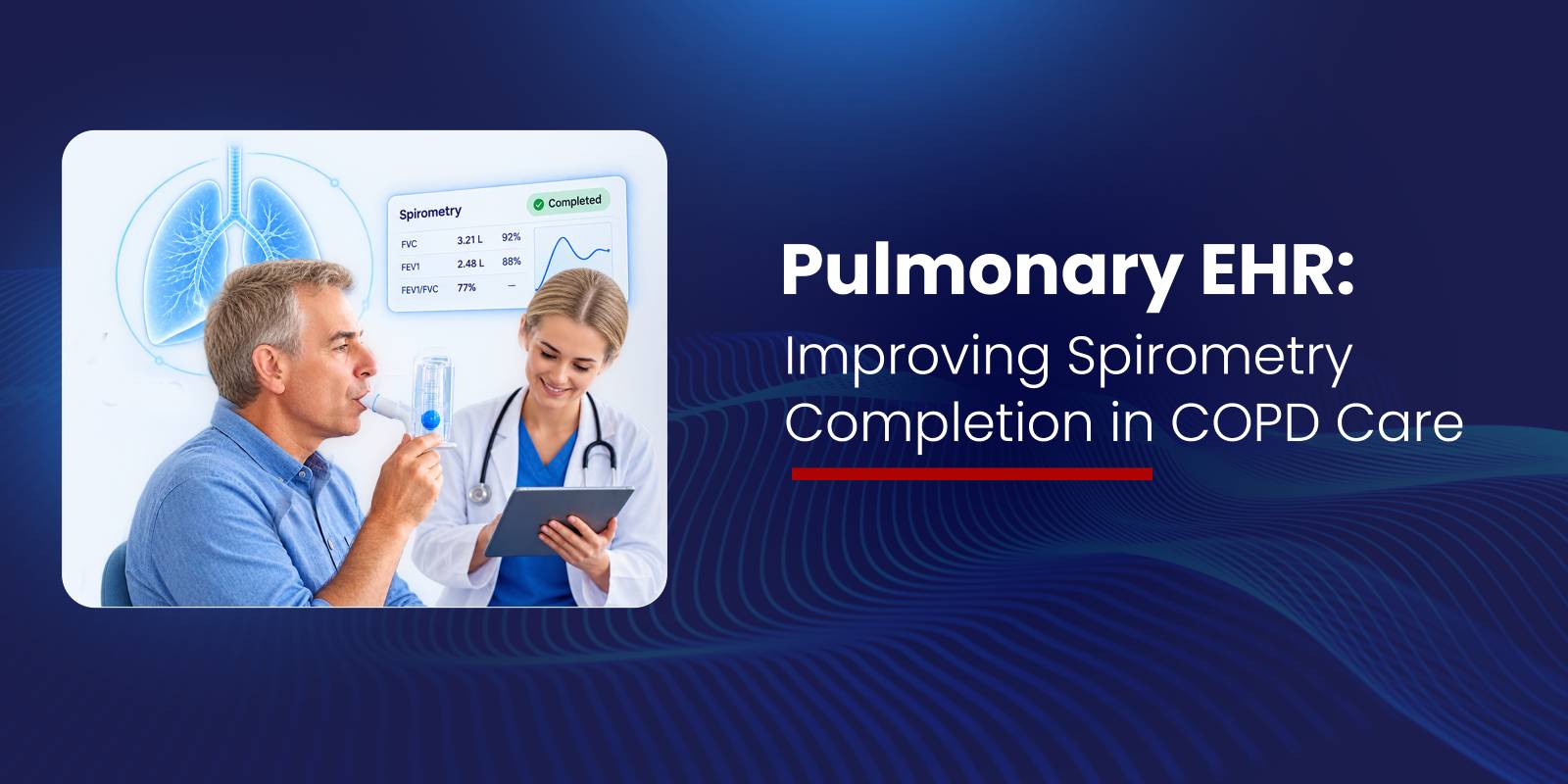
Nearly 16 million adults in the United States are impacted by COPD, a chronic respiratory condition that affects lung function, according to the Centers for Disease Control and Prevention (CDC), and many more people may remain undiagnosed. COPD can cause persistent breathing difficulties and is a leading cause of death in the United States. Early and accurate diagnosis is an important part of managing the disease and helping patients receive appropriate care.
Spirometry remains a key diagnostic test for COPD. It measures how much air a person can inhale and exhale and how quickly they can force air out of the lungs. When integrated into an effective clinical workflow, spirometry can help clinicians confirm airflow obstruction and distinguish COPD from other conditions with similar respiratory symptoms.
However, patients who have been identified as being at risk for COPD may not always complete pulmonary function testing promptly. EHR-based interventions can help practices identify patients who need testing, facilitate referrals and orders, and support follow-up throughout the diagnostic process.
The Role of EHR Interventions in COPD Spirometry
A 2022 study published in COPD: Journal of Chronic Obstructive Pulmonary Disease examined whether electronic health record interventions could increase spirometry referrals and completion among patients with COPD who had not previously received confirmatory testing.
Researchers identified patients with a COPD diagnosis who were eligible for the study and compared outcomes before and after implementing EHR-based interventions. The interventions included:
-
Provider-facing health maintenance reminders:
The EHR identified patients with a COPD diagnosis who had not completed spirometry and prompted providers to consider pulmonary function testing.
-
An updated spirometry order:
Researchers simplified the existing ordering process so providers could place spirometry orders directly through the EHR.
-
Patient portal communication:
Patients received messages through the portal encouraging them to schedule spirometry testing.
The results demonstrated a measurable improvement in both referrals and completed tests. Spirometry referrals increased from 20.2% before the intervention to 31.6% after the intervention, while completion increased from 13.2% to 19.3%. The researchers concluded that a coordinated EHR intervention modestly increased spirometry referrals and completion and also helped identify patients whose COPD diagnosis was not supported by evidence of airflow obstruction.
These findings illustrate an important role for the EHR beyond documentation. Well-designed clinical workflows can help practices identify gaps in testing and create more consistent pathways from diagnosis to appropriate pulmonary evaluation.
What Has Changed in COPD Care in 2026?
The importance of spirometry has continued into 2026. The Global Initiative for Chronic Obstructive Lung Disease (GOLD) released its 2026 Report, providing updated evidence-based recommendations for the prevention, diagnosis and management of COPD.
In March 2026, GOLD and the Global Lung Function Initiative (GLI) also published a joint statement addressing the use and interpretation of spirometry for diagnosing COPD. The organizations reaffirmed that spirometry is essential for confirming COPD and called for greater use of testing to help address persistent underdiagnosis.
This makes reliable pulmonary testing workflows particularly relevant for practices looking to improve COPD case finding and diagnostic follow-through.
Key Pulmonology Trends for 2026
Several developments are shaping how pulmonary practices approach COPD diagnosis and ongoing care:
Current guidance continues to emphasize objective confirmation of airflow obstruction rather than relying solely on clinical suspicion or a historical diagnosis.
EHR data can help practices identify patients who may warrant further evaluation based on documented diagnoses, symptoms, risk factors and previous testing.
Pulmonary care involves more than ordering a test. Practices also need workflows for documenting results, communicating with patients, monitoring symptoms and coordinating subsequent care.
GOLD's 2026 publications include discussion of how artificial intelligence could contribute to COPD diagnosis and management. These technologies remain an evolving area of clinical research and should complement, rather than replace, appropriate clinical assessment and diagnostic testing.
For pulmonary practices, the broader trend is toward using clinical technology to make important steps in the care pathway more visible, consistent and actionable.
How a Pulmonary EHR Can Support Spirometry Workflows
A pulmonary-focused EHR can help practices connect clinical documentation, diagnostic testing and practice workflows within a single environment.
ModuleMD's pulmonary EHR SaaS is designed to support pulmonology practices with specialty-specific workflows for pulmonary care, including spirometry and diagnostic pulmonary testing. By incorporating clinical and administrative workflows into the same platform, practices can reduce unnecessary manual steps and make important information easier to access.
Depending on the practice's workflow, an EHR can support processes such as:
- Identifying patients who may require pulmonary testing
- Documenting spirometry and pulmonary function testing with connected devices
- Maintaining patient records within a centralized system
- Connecting clinical documentation with practice-management activities
- Supporting billing and revenue-cycle workflows
- Giving providers access to relevant patient information during care
The goal is not simply to add another reminder or digital tool. The larger opportunity is to create a connected workflow in which patient information, testing, documentation and follow-up work together.
Connecting Pulmonary Care with Practice Management
The 2022 EHR intervention study demonstrated that targeted electronic workflows can increase spirometry referrals and completion among patients with COPD who had not previously received testing. The 2026 GOLD and GOLD/GLI updates reinforce the continued importance of appropriate spirometry in confirming COPD.
Together, these developments highlight an important opportunity for pulmonary practices: use technology not just to document care, but to help identify gaps, support appropriate testing and create more consistent follow-up workflows.
For practices looking to modernize pulmonary care, a specialty-focused EHR can provide the infrastructure needed to connect these processes.
Ready to Strengthen Your Pulmonary Practice Workflow?
Explore how ModuleMD's pulmonary EHR SaaS can help connect clinical workflows, pulmonary testing, practice management and revenue-cycle processes in one platform.
Schedule a ModuleMD demo to see how a pulmonary-focused EHR can support your practice.
SCHEDULE A DEMO- CDC. About COPD. View source
- Wang C, et al. EHR Intervention and Spirometry Completion in COPD. 2022. View study
- GOLD. 2026 Report. View report
- GOLD/GLI. Joint Statement on Spirometry and COPD. 2026. View statement
- Wells BJ, et al. EHR Algorithm for COPD. 2026. View study