
ENT practices are experiencing growing patient demand, increasing administrative complexity, and ongoing staffing challenges that are putting pressure on daily operations. More patients are scheduling appointments. ENT providers are seeing increased demand for continued patient care at a time when recruiting and retaining experienced staff remains a significant challenge. And through all of it, the administrative workload keeps growing.
The pressure isn’t coming from one direction. It's converging from several at once. And for practice administrators, clinicians, and office managers trying to hold everything together, understanding what's driving it is the starting point for doing something about it.
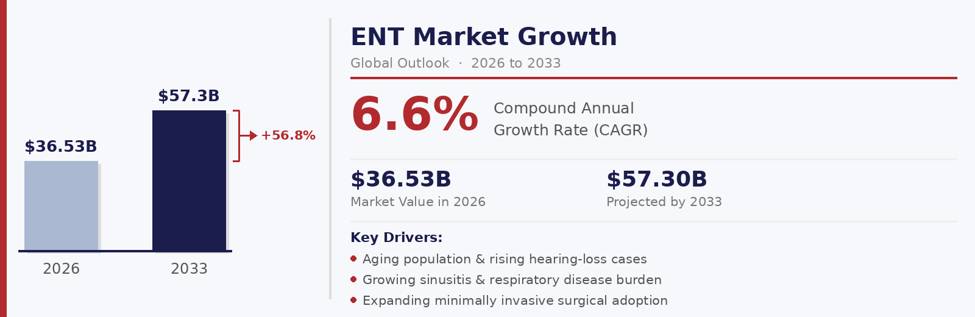
According to Coherent Market Insights, the ENT disorder treatment market is projected to grow from $36.53 billion in 2026 to $57.30 billion by 2033, reflecting continued growth in patient demand across ENT-related conditions.
Age-related hearing loss is one of the most common and underdiagnosed conditions in adults over 60, and that population is growing rapidly. As the aging population continues to grow, ENT practices are seeing increased demand for hearing evaluations, hearing support devices, tinnitus care, and cochlear implant consultations.
It doesn't stop at the ear. Older patients are also more likely to present with chronic nasal conditions, voice disorders, and obstructive sleep apnea, all squarely in the ENT scope of practice. More patients with more complex, overlapping needs means longer appointments, more follow-ups, and less room in the schedule for new cases.
The demographic trend isn't going to reverse. ENT practices need to be built to handle this volume, or risk turning away patients they can't accommodate.
Chronic sinusitis affects millions of U.S. adults and is one of the most frequently seen conditions in ENT practices. What makes it operationally demanding isn't just the volume, it's the chronicity. These patients don't come in once. They cycle through consultations, imaging, medication management, allergy workups, and sometimes surgical planning. A single chronic sinusitis patient can generate a dozen encounters a year.
ENT practices are also seeing increased sinusitis caseloads driven by environmental allergens, respiratory health concerns, and post-viral conditions. Recurring ENT cases can create operational strain for practices that lack streamlined clinical documentation and workflow management processes.
Healthcare staffing is in a prolonged crisis, and ENT isn't immune. Specialist positions take significantly longer to fill than primary care roles. Experienced MAs, front desk coordinators, and billers are leaving for higher-paying opportunities elsewhere. Clinician burnout is accelerating retirements.
The result is many ENT practices operating with reduced capacity while continuing to manage increasing patient demand. Remaining staff absorb the extra load, which fuels more burnout, which leads to more turnover. It's a cycle that's difficult to break without structural changes to how work gets done.
Practices that depend only on adding more staff to keep up with patient demand may continue to face operational challenges. The only way to serve more patients without burning through staff is to make every hour of every role count, and that requires the right systems in place.
Documentation, prior authorizations, insurance denials, coding complexity, compliance tracking, and the administrative burden on ENT practices have never been heavier. ENT documentation is inherently detailed: audiograms, surgical procedure notes, allergy test results, and imaging reviews. When the systems handling that documentation aren't purpose-built for ENT, the charting takes longer, errors creep in, and reimbursement cycles extend.
Clinicians end up doing documentation work after hours. Staff spend time on manual data entry instead of patient interaction. Billing errors lead to claim rework. None of it shows up on a patient satisfaction survey, but all of it erodes practice performance.
As documentation requirements and reimbursement complexity continue to increase, many ENT practices are also experiencing growing pressure on revenue cycle performance and claim management workflows.
The practices managing this pressure best aren't doing it with more staff or longer hours. They're doing it with smarter workflows. That means:
Efficiency isn't about cutting corners. It's about making sure clinical time goes toward patients, not paperwork.
The ENT market is growing. Patient demand is rising. The practices that thrive will be the ones that get operationally ahead of it now, not after capacity breaks down.
The right technology, workflows, and practice management infrastructure aren't a luxury at this point. They're what separates a practice that grows with demand from one that gets crushed by it.
Learn how ModuleMD helps ENT practices improve workflow efficiency, streamline documentation, and support stronger operational performance.
to explore specialty-focused solutions designed for modern ENT practices.

You may like these too…