ENT care is shifting from hospital operating rooms to outpatient clinics and ambulatory surgery centers, led by balloon sinuplasty performed under local anesthesia. The shift is driven by improved minimally invasive devices, a global ENT treatment market growing from $36.53 billion in 2026 to $57.30 billion by 2033, and patients who increasingly expect same-day recovery over multi-day hospital stays.
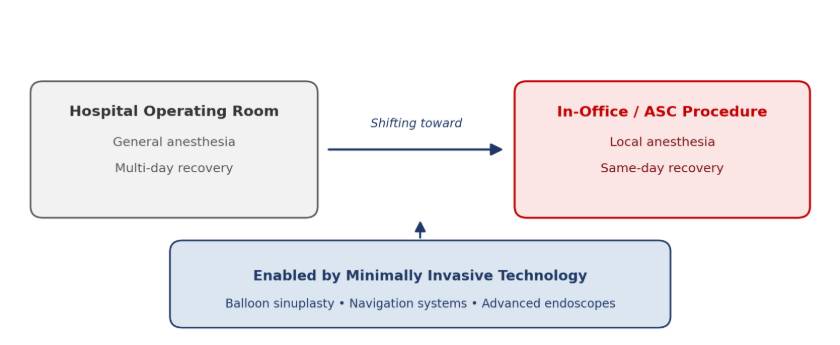
Ear, nose, and throat care is in the middle of a quiet but decisive transformation. For decades, treating chronic sinus disease or airway obstruction meant an operating room, general anesthesia, and a multi-day recovery. That model is fading fast.
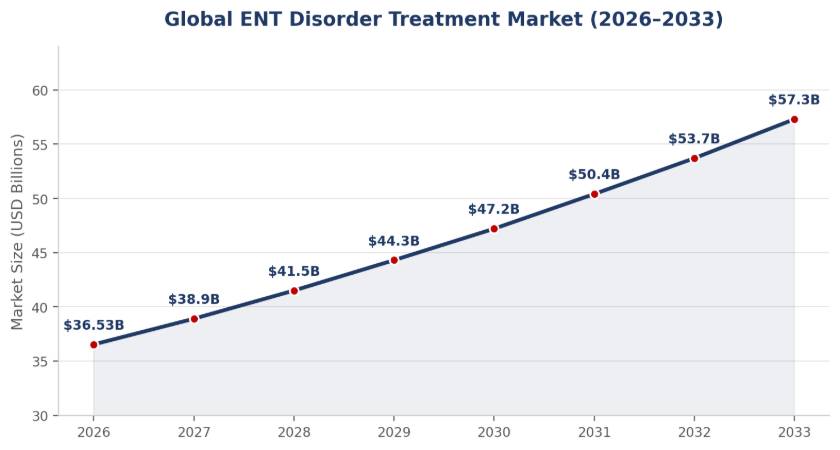
Today, minimally invasive ENT procedures, led by balloon sinuplasty, are moving out of hospital operating rooms and into outpatient clinics, ambulatory surgery centers (ASCs), and clinician offices. According to Coherent Market Insights, the global ENT disorder treatment market is projected to grow from $36.53 billion in 2026 to $57.30 billion by 2033, and a meaningful share of that growth is tied directly to less invasive, faster-recovery treatment options.
For practice leaders, this isn't a future trend to watch, it's an operational shift already underway. This article breaks down what's driving it, what it means clinically, and what ENT practices need to get right to capture the opportunity.
The data points referenced throughout are drawn from published market research and industry reporting, cited at the end of this article, rather than presented as original clinical findings.Why outpatient ENT care is accelerating
Shorter Recovery WindowBalloon sinuplasty is reshaping treatment pathways
Balloon sinuplasty uses a small inflatable catheter to widen blocked sinus passages without removing tissue. Compared with traditional functional endoscopic sinus surgery (FESS), it typically means less bleeding, fewer complications, and a dramatically shorter recovery window.
This matters because chronic sinus disease isn't rare. Chronic sinusitis affects millions of adults and remains one of the most frequently seen conditions in ENT practices, creating a large, steady population of candidates for intervention. As balloon-based techniques have matured, they've shifted from a niche add-on to a frontline option for many of these patients, one that doesn't require a hospital stay.
Where care happensOffice-based procedures are becoming the default, not the exception
The bigger story isn't just that balloon sinuplasty works, it's where it's happening. A growing share of these procedures are now performed under local anesthesia directly in a clinic setting, skipping the OR entirely.
This pattern mirrors what already happened in gastroenterology and ophthalmology, where procedures steadily moved from hospital outpatient departments into ASCs and clinician offices. ENT is following the same curve, driven by patient convenience, lower per-procedure cost, and improving device technology that makes in-office treatment clinically safe.
Patient expectationsPatients now expect a faster recovery
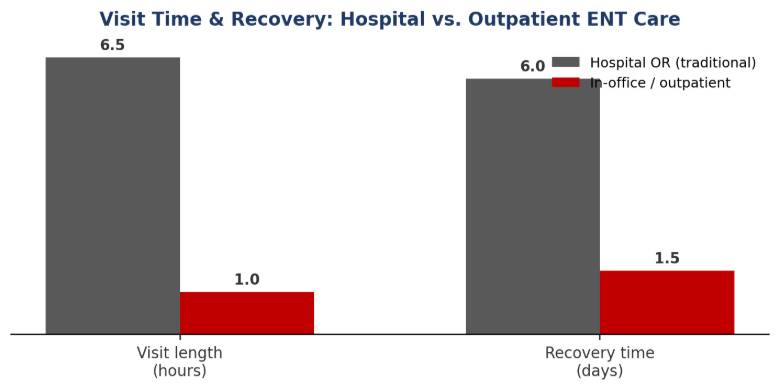
Patient expectations have shifted alongside the technology. Office-based ENT procedures generally involve significantly shorter total visit times than a comparable hospital admission, often measured in an hour rather than a full day plus a recovery week.
For working adults managing recurring sinus issues, that difference is often the deciding factor in choosing both a treatment path and a provider. Practices that can reliably deliver "in and out in an hour" have a real competitive advantage.
What's enabling itTechnology is making the shift clinically viable
None of this would be possible without real device advancement. Several developments are accelerating the move toward outpatient ENT care:
- AI-assisted diagnostics and telemedicine, improving remote triage and follow-up
- Advanced endoscopic visualization systems, newer imaging platforms built for flexible use in both office and outpatient settings
- Image-guided navigation tools, increasing precision during in-office balloon procedures
- FDA-cleared minimally invasive instruments, expanding what can safely be done outside the OR
North America in particular is leaning into AI-powered diagnostics, robotic-assisted surgery, and minimally invasive techniques like balloon sinuplasty as part of a broader regional shift toward outpatient-first ENT care.
The operational realityOperational efficiency is pushing practices to adapt
The clinical and patient-experience case for outpatient ENT care is strong, but it creates real operational demands. Practices moving more procedures in-house typically need to manage:
- Capital investment in balloon systems, navigation equipment, and in-office imaging
- Staff training for procedures previously referred out to a surgical team
- Scheduling redesign, since in-office procedure slots run differently than OR block time
- Accurate documentation and coding, since in-office and facility-based billing differ significantly
- Clear patient communication to set expectations for a same-day, low-anesthesia procedure
Practices that treat this purely as a clinical decision, without addressing scheduling, staffing, and billing, often capture the patient experience benefit but leave financial value on the table.
Side by sideHospital vs. outpatient ENT care : a quick comparison
| Factor | Traditional hospital-based care | Outpatient / in-office care |
|---|---|---|
| Setting | Operating room | Clinic or ambulatory surgery center |
| Anesthesia | General anesthesia | Local anesthesia (typically) |
| Typical visit length | Half-day to full-day admission | Often under an hour |
| Recovery time | Several days | Often 1–2 days or less |
| Best suited for | Complex cases, significant polyps, anatomical abnormalities | Chronic sinusitis, standard balloon dilation cases |
| Cost profile | Highest, due to facility fees | Lower, due to reduced facility overhead |
| Patient experience | More disruptive to daily routine | Minimal disruption, faster return to normal activity |
This isn't an either-or shift. Complex cases still require a hospital setting. But for an increasingly large share of routine sinus and airway cases, outpatient care is becoming the clinically appropriate first choice, not just the convenient one.
Where this leaves practicesConclusion
The move toward minimally invasive and outpatient ENT care isn't a passing trend, it's the direction the entire specialty is heading, supported by real clinical evidence, improving technology, and a patient population that increasingly expects fast, low-disruption treatment. Balloon sinuplasty's evolution from a niche alternative into a mainstream option is the clearest example, but it reflects a broader pattern already proven in other specialties.
ENT practices that build the staffing, scheduling, and billing infrastructure to support this shift now, rather than reacting to it later, will be best positioned as patient demand and procedure volume continue to grow.
Ready to evaluate how prepared your practice is?
Talk to a ModuleMD specialist about building the workflows, documentation, and billing infrastructure your ENT practice needs to deliver faster, in-office care without sacrificing quality or revenue.
Schedule a demo →