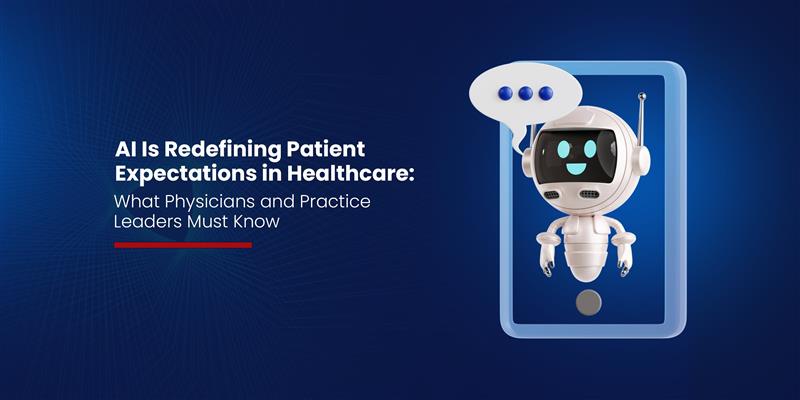
Artificial intelligence is no longer a future disruptor in healthcare. It is already influencing patient behavior, expectations, and clinical conversations.
Millions of individuals now use AI-powered health assistants to research symptoms, interpret lab reports, analyze wearable device data, and prepare questions before appointments. By the time many patients enter the exam room, they are equipped with AI-generated insights about their condition.
This evolution is already influencing clinical workflows and patient interactions in real time.
Patients are increasingly arriving with:
In many cases, this improves engagement. Conversations can move more quickly into shared decision-making rather than basic explanation. Health literacy improves. Patients feel more empowered.
However, there is another side.
Clinicians are also spending time clarifying inaccuracies, correcting overgeneralizations, and reframing AI-generated conclusions that may not apply to an individual’s medical history. What was meant to streamline visits can sometimes complicate them.
AI produces information.
Clinicians provide interpretation.
That distinction is critical.
Consumer health tracking has expanded rapidly. Patients now collect large volumes of data, including heart rate variability, glucose readings, sleep metrics, activity levels, and more.
AI tools can organize and summarize this information in seconds. For busy practices, that capability has promise.
But reliability depends on three factors:
Without all three aligned, conclusions may mislead rather than inform.
As AI usage grows, healthcare organizations must address governance.
Many public AI platforms are not automatically configured for healthcare regulatory compliance. Patients may upload sensitive medical information without understanding how it is processed or stored. Clinicians may experiment with AI tools without formal institutional guidance.
Practice leaders should be asking:
Ignoring these questions increases risk.
Historically, clinicians were the primary gatekeepers of medical knowledge. Today, information is widely accessible, and conversational AI accelerates that access.
This is not a temporary trend. It represents a structural change in healthcare communication.
Rather than competing with AI, forward-thinking practices are learning how to integrate it responsibly, supporting patient engagement while maintaining clinical oversight.
AI may shape the conversation.
But clinical expertise remains the foundation of care.
At ModuleMD, we recognize that AI is becoming part of the healthcare ecosystem, both inside and outside the exam room.
Our AI-enabled solutions are designed specifically for medical practices, helping streamline documentation, improve coding accuracy, enhance revenue cycle performance, and support operational efficiency, all within a secure, healthcare-focused framework.
As patient expectations evolve, practices need technology that strengthens both clinical care and financial stability.
AI is here.
The question is whether your systems are built to handle it responsibly.
You may like these too…