
Prior authorization challenges don't usually start with one major failure. More often, they build through small process gaps that slow teams down, delay patient access, and create avoidable rework.
This piece looks at what's behind that strain — and how physician organizations can make prior authorization clearer, more consistent, and easier for care teams to manage.
Every pending authorization represents more than paperwork. It represents a patient waiting for treatment, a provider waiting to deliver care, and a practice absorbing the cost of delay.
This isn't rare. It's becoming routine.
Prior Authorization by the Numbers
Prior authorization was built to confirm treatments meet coverage requirements before care begins. In practice, it's become one of the heaviest administrative burdens in healthcare.
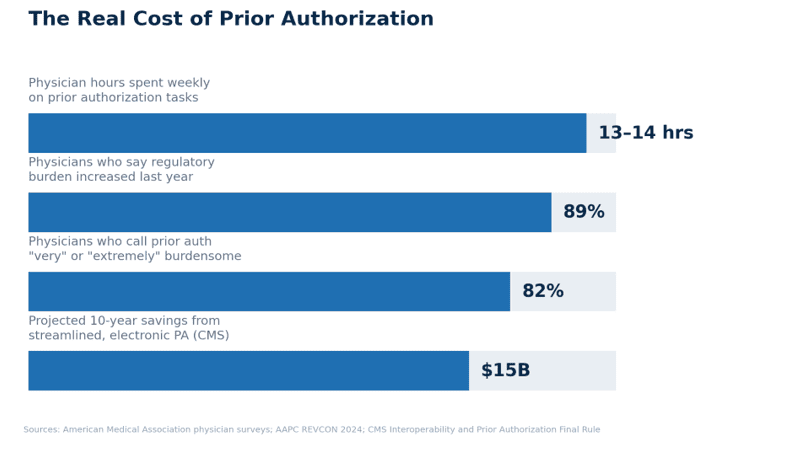
That workload shows up across the board, according to the American Medical Association (AMA):
For specialty practices in allergy, immunotherapy, biologics, pulmonology, and infusion therapy, these delays directly impact daily operations and patient care.
Why It Keeps Getting Harder
Every payer has its own documentation rules, submission process, and approval timeline. What used to be one phone call now means:
- Multiple portals and systems to manage
- Repeated documentation requests for the same information
- Ongoing follow-up before a decision is even reached
The result, in three lines:
The Ripple Effect
A delayed prior authorization doesn't just postpone treatment. It increases administrative workload, slows clinical workflows, and affects the financial performance of the entire practice.
| Impact on Patients | Impact on Providers | Impact on Organizations |
|---|---|---|
| Delayed treatment | Heavier documentation load | Higher administrative costs |
| Missed appointments | More time on payer follow-up | Revenue delays |
| Increased anxiety | Staff burnout | Greater denial risk |
| Interrupted continuity of care | Reduced clinical productivity | Lower operational efficiency |
High-value therapies feel this the hardest, since treatment schedules depend entirely on timely approval.
How Leading Healthcare Organizations Are Modernizing Prior Authorization
Standardize documentation before submission
Consistent templates for medical necessity, diagnosis history, and supporting evidence catch gaps before a payer ever sees the request.
Connect the workflow
When scheduling, EHR, billing, and payer portals don't talk to each other, staff re-enter the same data repeatedly. Integration removes that duplication.
Let AI handle the repetitive work
AI doesn't replace clinical judgment — it removes the manual grind around it. It can:
- Flag which services require prior authorization
- Pull clinical details straight from the patient record
- Catch missing documentation before submission
- Prioritize high-risk cases
- Track authorization status automatically
Build one centralized view
Speed isn't the real problem — visibility is. Without a single dashboard, most issues surface only after a delay or denial. A centralized view should show:
- Pending authorizations
- Approvals and denials
- Requests awaiting documentation
- Expiring authorizations
- Appeal status
- Average payer turnaround time
Track the metrics that matter
Turnaround time, denial rate , approval rate, and appeal success show exactly where the workflow still breaks.
Momentum Is Already Building
This isn't just a practice-level fix — the industry is moving.
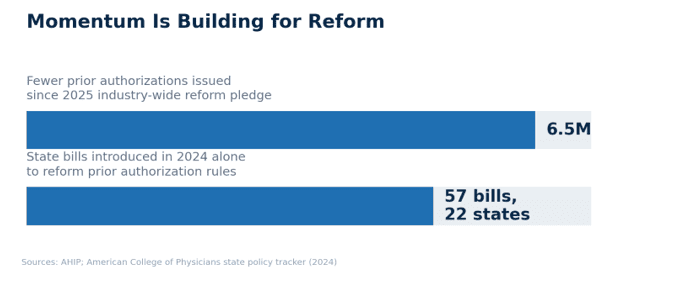
- 57 bills introduced across 22 states in 2024 alone to reform prior authorization requirements.
- 2027 Starting this year, most payers will be required to issue PA decisions within 72 hours for urgent requests and 7 days for standard ones.
- $15B CMS estimates its interoperability and prior authorization final rule will save this much over the next decade.
Regulation and technology are converging on the same outcome: less friction, faster decisions.
Traditional vs. Intelligent Prior Authorization
| Traditional | Intelligent |
|---|---|
| Manual documentation collection | Automated clinical data capture |
| Multiple payer portals | Unified authorization workspace |
| Phone calls and faxes | Electronic prior authorization (ePA) |
| Spreadsheet tracking | Real-time dashboards and alerts |
| Reactive denial management | Predictive risk identification |
| Repetitive admin work | AI-assisted automation |
Four Pillars of a Future-Ready Strategy
The Bottom Line
Prior authorization isn't about processing more requests. It's about building workflows where the right information reaches the right payer at the right time — with fewer manual steps, fewer delays, and better outcomes for everyone involved.
For specialty practices managing allergy, immunotherapy, biologics, and infusion services, every faster approval means fewer scheduling disruptions, stronger revenue cycle performance, and faster access to care for patients who need it most.
Ready to simplify prior authorization at your practice?
Book a Demo →