
Modifier 25 already requires careful documentation. Under CMS's 2027 proposal, the financial impact of certain same-day claims could become more significant, not because the modifier is being eliminated, but because Medicare would change how qualifying services are paid.
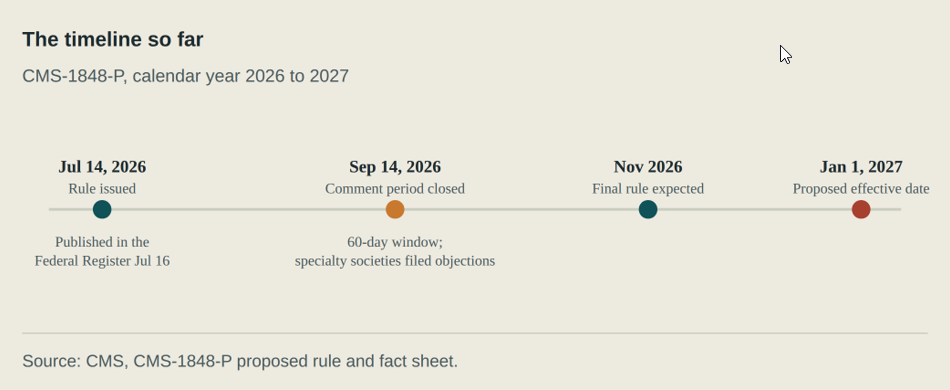
CMS is proposing changes to Medicare payment rules for 2027 that could affect how practices report and receive reimbursement for certain E/M services. The agency released the CY 2027 Medicare Physician Fee Schedule proposal (CMS-1848-P) on July 14, 2026, followed by Federal Register publication on July 16. The proposed changes specifically address situations in which a separately identifiable office or outpatient E/M service is reported with Modifier 25 on the same day as a procedure carrying a 0-, 10-, or 90-day global period.
The rule isn't final. But for practices that routinely bill an E/M visit and a procedure during the same encounter, the shape of the proposal is already worth understanding.
What CMS is proposing
The proposal is narrower than saying “Modifier 25 is being cut. “ Under the proposal, when qualifying same-day E/M and procedure services are reported for the same patient, the highest-valued eligible service would be paid at 100%. Other qualifying services subject to the policy would be paid at 50% of the applicable amount.
That distinction matters: the policy doesn't eliminate Modifier 25 or bar E/M-and-procedure billing on the same day. It would change how Medicare pays for additional qualifying services reported on the same day.
Where it lands across specialties
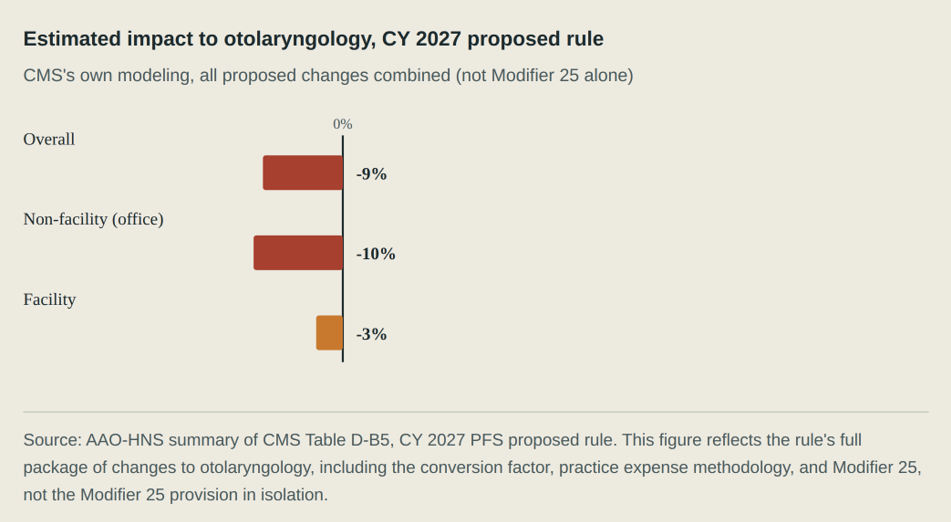
Same-day E/M-and-procedure billing is routine across procedure-heavy specialties. Allergy and immunology, ENT, pulmonology, and infusion practices should review how often they report these combinations. Not every same-day pairing will fall inside the proposal's scope, since eligibility depends on the specific services and global-period rules involved.
| Specialty | Typical same-day combination |
|---|---|
| Allergy & Immunology | E/M evaluation provided during a qualifying procedure encounter |
| ENT | Office E/M services reported with qualifying procedures subject to a global period |
| Pulmonology | Same-day E/M services reported with qualifying procedures |
| Biologics & Infusion | E/M services reported with qualifying procedures, where applicable |
The more useful question isn't how many Modifier 25 claims a practice files. It's which of those claims involve services that would actually sit inside the proposed payment policy.
Modifier 25 still means what it always meant
The payment change doesn't touch the underlying coding rule. Modifier 25 applies when a clinician provides a significant, separately identifiable E/M service on the same day as another procedure or service. It doesn't apply simply because two services happened to occur on the same date.
An allergy physician evaluating a patient's condition and adjusting a treatment plan, in addition to performing an eligible procedure, is doing separately identifiable work. An ENT physician managing a distinct clinical issue alongside an in-office procedure is doing the same. The medical record must demonstrate that the E/M evaluation involved clinical work distinct from the procedure. The proposal would not eliminate the existing coding and documentation requirements for Modifier 25; it would change Medicare payment for qualifying same-day services.
The revenue cycle question underneath the coding question
Before any final rule takes effect, practices have a reason to establish a real baseline across six areas:
Reporting frequency
How often Modifier 25 has been reported across the last 12 months of claims.Common combinations
Which E/M and procedure pairings occur most often and which may fall within the proposed policy.Payer-level denials
Which payers generate the most Modifier 25 denials, and why?Documentation support
Whether a sample of encounters actually shows a distinct, separately identifiable E/M service.Staff time
How much staff time is currently spent correcting, resubmitting, or appealing these claims.A/R exposure
What share of outstanding receivables ties back to these claims.
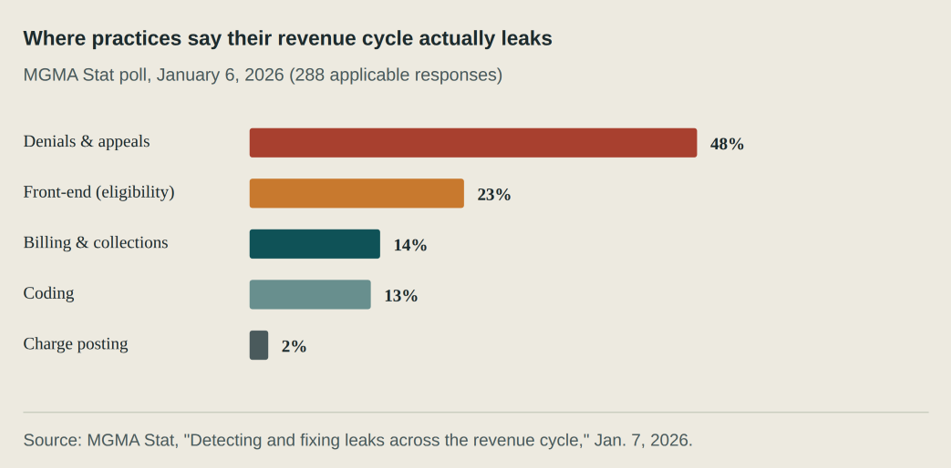
That split matters for Modifier 25 specifically, because it splits into two separate questions with two separate fixes: are eligible claims being paid correctly under current rules, or are they being denied outright because documentation or payer requirements weren't met? A future payment reduction would change the economics of an otherwise payable claim. A denial, by contrast, can delay or prevent payment while also creating additional administrative work.
What the national numbers show
A Milliman analysis commissioned by the American Academy of Dermatology Association modeled the proposed policy using 2024 Medicare fee-for-service claims. The analysis estimated approximately $969 million in reduced Medicare FFS allowed amounts under the proposed policy, based on 2024 claims. That represents roughly 1% of total Medicare Physician Fee Schedule allowed amounts nationally.
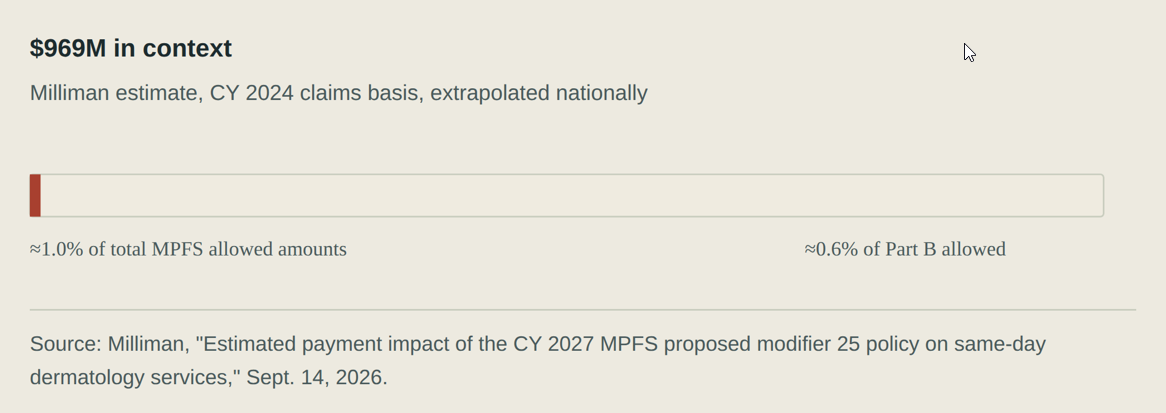
That's a national estimate, not a forecast for any individual practice. Actual exposure would vary by practice based on Medicare volume, service mix, and the frequency of qualifying same-day service combinations.
What to do before the final rule lands
- 1. Review Modifier 25 volumePull the last 12 months of claims and quantify how often providers report it.
- 2. Map the common combinationsIdentify the E/M and procedure pairings that occur most often and determine which may fall within the proposed policy.
- 3. Break down denialsSort Modifier 25 denials by payer, provider, procedure pairing, reason, and location.
- 4. Audit a documentation sampleConfirm that a representative set of encounters actually supports a distinct, separately identifiable E/M service.
- 5. Model the exposureApply the proposed 50% payment reduction to qualifying additional services in your Medicare claims data to estimate potential financial exposure.
- 6. Track the final ruleCMS closed the comment period on September 14, 2026. The final rule is expected in November 2026.
Frequently asked questions
Is the 50% Modifier 25 reduction final?
No. It's part of the CY 2027 Medicare Physician Fee Schedule proposed rule. The comment period closed September 14, 2026, and CMS is expected to issue a final rule in November 2026.
Does the proposal eliminate Modifier 25?
No. It changes payment for certain eligible same-day service combinations. The modifier itself and its coding requirements stay in place.
Does reporting Modifier 25 guarantee separate payment?
No. The E/M service must still meet the coding requirements and be documented as significant and separately identifiable from the procedure.
Will every same-day E/M and procedure claim be cut by 50%?
No. The proposal applies specifically to qualifying office or outpatient E/M services reported with Modifier 25 alongside a procedure with a 0-, 10-, or 90-day global period.
What should practices do now?
Review Modifier 25 volume, map the common service combinations, break down denials, audit documentation, model potential Medicare exposure, and track the final rule.
Build a more connected revenue cycle
Modifier 25 is one example of how documentation, coding, claims, and payment are connected across the revenue cycle. ModuleMD brings EHR, practice management, and revenue cycle tools together on one platform built for specialty practices, helping teams maintain visibility from the clinical encounter through the claim and payment process.
See ModuleMD in actionSources
- CMS-1848-P: CY 2027 Medicare Physician Fee Schedule Proposed Rule Centers for Medicare & Medicaid Services. Confirms issue date (Jul. 14, 2026), Federal Register publication (Jul. 16, 2026), and comment deadline (Sep. 14, 2026).
- Estimated payment impact of the CY 2027 MPFS proposed modifier 25 policy on same-day dermatology services Milliman, commissioned by the American Academy of Dermatology Association. Source of the $969M national estimate and the ~1% MPFS-allowed share.
- Detecting and fixing leaks across the revenue cycle MGMA Stat, Jan. 7, 2026. Source of the denials/appeals, front-end, billing/collections, coding, and charge-posting breakdown.
- AAO-HNS Summary of CY2027 MPFS Proposed Rule American Academy of Otolaryngology–Head and Neck Surgery. Source of the otolaryngology impact estimates and the November 2026 final-rule expectation.